Approved Document B: How New Guidance Affects Fire Doors, Detection, and Alarm Systems
24 September 2026
Summary
As the cornerstone technical guidance supporting the building regulations approved document b, Approved Document B (ADB) dictates how modern commercial, educational, and residential buildings are designed, constructed, and operated. For facility managers, developers, and building owners, navigating these evolving technical standards is essential for achieving building control sign-off and ensuring long-term life safety.
This article explores the latest shifts in physical infrastructure, upgraded fire door regulations, advanced detection networks, and sector-specific compliance challenges.
Key Takeaways
- Understanding the specific requirements outlined across both approved document b vol 1 (dwelling houses) and approved document b vol 2 (buildings other than dwelling houses) is critical for specifying compliant materials.
- Strict fire door standards and modern regulations on fire doors require seamless integration between physical hardware, glazing integrity, and electronic access systems.
- Modern estates rely on a sophisticated addressable fire alarm system to eliminate blind spots and pinpoint exact activation points during an emergency.
- Partnering with an NSI Gold-approved specialist ensures that your approved document part b and broader approved document b fire safety strategies remain watertight from design to maintenance.
The Regulatory Landscape: Navigating ADB in 2026
Building safety regulations across the UK continue to evolve in response to higher accountability, technological advancements, and rigorous oversight. Approved Document B remains the definitive framework for meeting structural fire safety requirements.
However, interpreting these guidelines requires careful attention to building classification. Whether you are referencing approved document b vol 1 for residential developments or approved document b vol 2 for commercial, industrial, and assembly buildings, the margin for error has narrowed.
For building managers embarking on major refurbishments or new builds, ensuring compliance under building regulations approved document b means looking beyond basic box-ticking to examine the entire life safety ecosystem.
Upgraded Fire Door Standards & Specifications
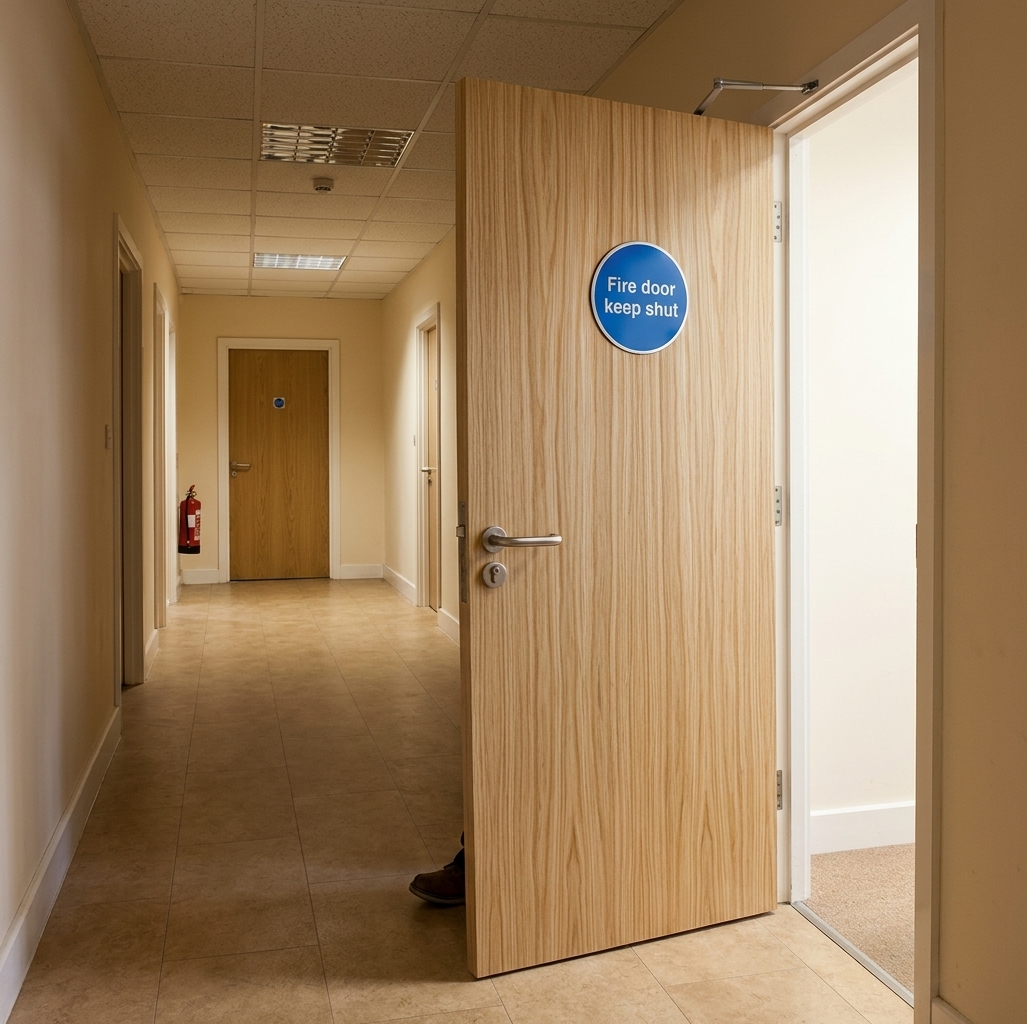
Fire doors serve as a building’s primary active and passive line of defence, designed to compartmentalise fire and smoke while facilitating safe evacuation. Yet, enforcement authorities are placing increased scrutiny on how these assets are specified, installed, and maintained.
Door Durability and Structural Integrity
- Modern doors must maintain their fire-resistance rating under severe thermal stress, requiring rigorous third-party fire door certification for every component in the assembly.
Access Control Integration
- In contemporary commercial and educational settings, fire doors are frequently tied into electronic access systems. Under current regulations on fire doors, these systems must interface flawlessly with life safety networks to automatically release or "fail-safe" upon alarm activation.
Hardware & Glazing Compliance
- Vision panels, intumescent seals, and self-closing devices must be rigorously documented to satisfy updated approved document b vol 2 benchmarks.
Advances in Fire Detection and Life Safety Infrastructure
Traditional, legacy fire alarm loops are rapidly being phased out in favour of smarter, highly adaptable infrastructure capable of providing real-time telemetry across sprawling property portfolios.
Addressable Detection Systems
- Implementing a modern addressable fire alarm system ensures that building management systems and emergency responders receive immediate room-level data regarding potential smoke or thermal anomalies.
Minimising Operational Disruption
- Advanced multi-sensor analytics reduce the risk of costly false alarms - a common pain point in high-traffic environments like university campuses or commercial hubs.
Ecosystem Cohesiveness
- Detection infrastructure must work hand-in-hand with perimeter security and access control.
- To explore how detection integrates with broader site surveillance, read our guide on commercial fire detection systems.
Sector-Specific Applications: Education and Hospitality
Complex estates - including multi-building schools, universities, and high-turnover hotels - face unique operational challenges that standard, generic safety layouts cannot adequately address.
High Occupant Turnover
- Student accommodation and hospitality venues experience constant changes in occupancy, meaning occupants are often unfamiliar with escape routes or evacuation procedures.
Integrated Estate Management
- Educational facilities require cohesive system designs where fire detection, CCTV, and physical boundaries communicate instantly.
To evaluate how your current protocols measure up against UK best practices, we recommend completing our Security, Fire, and Life Safety Self-Assessment Checklist to identify priority areas before your next audit.
Navigating Technical Specifications with A-Plus Security
Complying with approved document part b requires rigorous technical expertise, precision engineering, and absolute consistency across every phase of your property’s lifecycle.
As an NSI Gold-approved security and fire specialist, A-Plus Security guides facility managers through complex technical specifications from initial architectural design to ongoing preventative maintenance. Whether you are updating a commercial portfolio or managing a multi-use education estate, our team provides the clarity needed to protect your people, property, and compliance record.
Ensure your upcoming projects meet the highest standards of safety and compliance.
Contact A-Plus Security today or call our expert team directly on 01702 293157 to schedule a professional technical review.